When to Schedule a Sprinkler Blowout in the Yakima Valley
The blowout window is shorter than most people think, and the crews fill up fast once the forecast turns cold.
October 7, 2026 · 4 min read
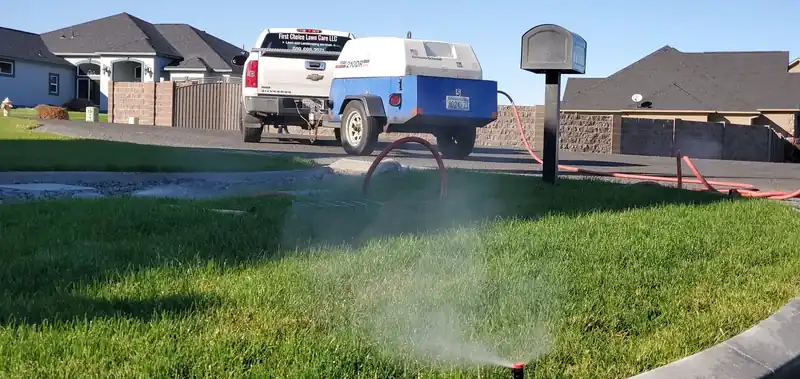
Every fall, somebody in the valley wakes up to a hard frost, looks out at the sprinkler heads, and realizes the water is still sitting in the pipes. Water expands when it freezes. A pipe, a valve, or a sprinkler head full of ice has nowhere to put the extra volume, so something gives. A blowout is the cheap way to make sure nothing does.
What a blowout actually does
A technician hooks an air compressor to your irrigation system, usually at the backflow assembly or a blowout port near it. The water supply gets shut off first. Then they open one zone at a time and push air through the lines until the heads stop spitting water and only a fine mist comes out. If you've seen a truck and a compressor trailer parked at a curb in October with hoses running across the lawn, that's this job.
The goal isn't a bone-dry pipe. It's getting enough standing water out that nothing is left to freeze solid and split a fitting. Doing the zones one at a time matters, because air takes the path of least resistance. A tech who opens everything at once leaves some zones half full. Running through the zones in sequence, and often cycling through them a second time, is how the low spots and long runs get cleared.
Why "after the first freeze" is too late
The right window opens when your lawn stops needing regular water and closes when the ground sees a sustained hard freeze. Light frosts in the valley tend to show up well before the nights that really threaten a system, and that gap is your opening. If you wait for the night the forecast says the temperature will crater, you're calling the same week as every other homeowner and every property manager in town.
One local wrinkle: if your system runs on irrigation district water instead of a well or city supply, the district may turn the water off for the season on its own schedule. Find out when that is. A system that goes quiet on the district's shutoff date still has water sitting in the lines downstream of the valves, and it still needs to be blown out.
The practical advice is simple. Call as soon as you're done watering most days. You pick a day that works for you, instead of taking whatever slot is left.
What happens when a blowout gets skipped
Plenty of winters are mild and nothing happens. That's exactly how people talk themselves out of it. When the damage does come, it lands in the same few places: the backflow assembly above ground, the valves in the boxes, the PVC fittings, and the sprinkler heads. A crack is invisible in December. You find it in spring, when you turn the system on and a geyser appears in the flowerbed or a zone never builds pressure.
Spring repairs also come at a bad moment. The first warm weekend, you discover three broken heads and a split valve, and so does everyone else on your street. Lawns that should be greening up wait on parts and appointments. Compare that to a blowout, which is usually a short visit and is over before dinner.
Getting your yard ready for the crew
You don't have to do much, but a few small things make the visit faster and the result better.
- Give the lawn its last good soak while the weather is still mild, so the grass goes into winter well watered.
- Walk the yard and note any head that was leaking, tilted, or misting oddly all summer, so it gets looked at while the tech is there.
- Clear plants, bark, and leaf litter away from valve boxes and the backflow assembly so they can be reached quickly.
- Tell the crew about drip lines and planter zones. Those take a gentler blowout than spray zones.
- Know where your main shutoff is, in case anything needs to be isolated.
Why a blowout visit is also a diagnosis
A tech who spends an hour moving through every zone sees things you don't. A head that sits too low and gets buried, a valve box full of water, a zone that takes far longer to clear than its neighbors and probably has a sag in the line. Those are the problems that turn into spring repairs. Catching them in October is a lot cheaper than finding out in April.
One customer, Natyssa Chavez, wrote that the crew "kept me informed about what was wrong and what they had to fix." That's the right standard for any irrigation visit. You should leave knowing the state of your system, not just that a truck came and went.
Booking yours
First Choice Lawn Care Services handles system blowouts alongside diagnosis, new systems, and repairs, for homes and commercial properties from Yakima County up to Kittitas County. If you'd like a blowout on the calendar before the cold sets in, call (509) 699-3071. Free estimates are available Monday through Saturday.
First Choice Lawn Care Services LLC, (509) 699-3071
Call (509) 699-3071More articles
Replacing a Tired Lawn With Sod, From Bare Dirt to First Mowing
Fresh sod looks great on day one. What decides whether it still looks great in August is the work nobody photographs.
Keeping Grass Out of Your Garden Beds With Concrete Curbing and River Rock
If you spend every weekend pulling grass out of the beds, the problem is probably the edge, not you.