Keeping Grass Out of Your Garden Beds With Concrete Curbing and River Rock
If you spend every weekend pulling grass out of the beds, the problem is probably the edge, not you.
October 7, 2026 · 4 min read
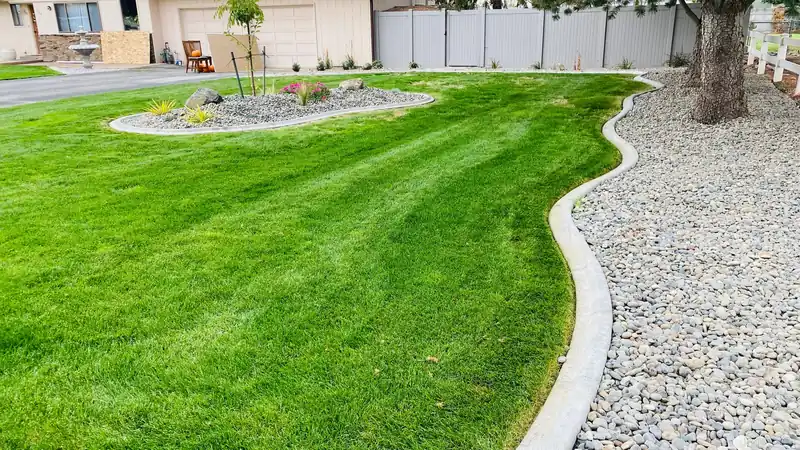
Most people who hate their garden beds don't really hate the plants. They hate the weekend routine: trimming the lawn edge, pulling the grass that's snuck under the mulch, chasing the weeds that came up in the gaps. Do that for a few summers and the bed starts to feel like a part-time job. Nikki Cook, a customer in the area, put it plainly. She wanted her yard gutted because "every year it was too much for me to take care of."
Why the grass wins against ordinary edging
Many lawn grasses spread sideways, not just up. They send out runners above and below the surface, and a bed full of loose mulch is an open invitation. Thin plastic edging gets pushed up by frost and by those same roots, and soon there's a gap along the top. Metal edging holds longer but still sits on the surface. It stops a mower. It doesn't stop a determined stem.
The reason a barrier needs to be heavy and deep is simple: grass goes over, under, and through whatever you put in its way, and it only stops when it hits something it can't push around.
How concrete curbing is made
Landscape curbing isn't blocks stacked along the lawn. A crew runs a curbing machine along the edge of the bed, and the machine extrudes a continuous ribbon of concrete in whatever shape you've laid out. Because it comes out in one piece, there are no seams for roots to find. The line can curve around a tree, wrap a mailbox, or run straight along a walk, and the top can be rounded so a mower wheel can ride right up against it.
The result is a solid lip between lawn and bed, poured on the ground and not just sitting on it. Grass roots run into the concrete and quit. The mower wheel rides the lip, so there's little or no trimming left to do along that line. It also gives the yard a finished, tailored look that a plastic strip never delivers, which is why a curved curb next to a gray rock bed and a green lawn is one of the cleanest looks a yard can have.
Why river rock instead of bark
Bark and wood mulch break down. You top it up every year or two, and the weeds seeded by wind and birds love it. River rock doesn't rot, doesn't blow away in a gust, and doesn't need replacing. Under the rock goes landscape fabric, which stops most weeds from coming up from below while still letting water through to the soil.
A fair warning, though. Rock reflects and holds heat on a sunny day, so plant choices matter in a dry, hot valley summer. And no bed is permanently weed-free. Seeds still land on top of the rock, with a little dust to sprout in. The difference is that those weeds pull out in seconds, not tangled up in a mass of grass roots.
What the build looks like, layer by layer
- Clear the bed of old plants, grass, and roots, and remove anything dying or in the way.
- Set the curb line and run the curbing machine along it, letting the concrete cure before heavy use.
- Grade and tamp the bed so water drains and the rock sits level.
- Lay fabric across the bed and cut openings for the plants you're keeping.
- Spread the river rock to an even depth, covering the fabric edges and meeting the curb.
One day, start to finish
Smaller beds don't need weeks of disruption. Nikki wrote that First Choice Lawn Care cleared the garden beds around the edge of her yard, laid river rock and new edging, took out a tree that was dying, and put down sod on bare spots, all in one day. "They did exactly what I wanted," she said, "and made it look better than I imagined." Bigger projects take longer, but the point is that a crew with the right equipment can rebuild a yard fast.
If you're deciding between curbing and a cheaper edge, ask yourself how many seasons you want to keep fighting the same strip of ground. For many homeowners and small commercial properties, the extra work up front pays for itself in lost weekends recovered.
Planning your own beds
First Choice Lawn Care Services, based in Zillah, builds concrete curbing and river rock beds around the Yakima Valley, and does the sod, the irrigation, and the cleanup that go with them. Call (509) 699-3071 and describe the strip of yard that keeps driving you crazy. Free estimates are available Monday through Saturday.
First Choice Lawn Care Services LLC, (509) 699-3071
Call (509) 699-3071More articles
When to Schedule a Sprinkler Blowout in the Yakima Valley
The blowout window is shorter than most people think, and the crews fill up fast once the forecast turns cold.
Replacing a Tired Lawn With Sod, From Bare Dirt to First Mowing
Fresh sod looks great on day one. What decides whether it still looks great in August is the work nobody photographs.